



Minimum weighing capacity as an appendix to the calibration certificate
What is the minimum weight that your balances can weigh while still providing accurate and reliable measurement results? Where exactly is the limit?
The KERN minimum weighing capacity protocol, attached to the calibration certificate with accreditation symbol, shows the determined minimum weighing capacity of your measuring instrument at its installation and operating location with the relative measurement uncertainty. This is possible for various safety factors and required weighing accuracies (process accuracies), depending on the normative or quality-related requirements for the weighing instrument used.
The higher the selected safety factor, the greater the safety when using the balance in a specific process. Typical disruptive influences when using the balance, such as minor temperature fluctuations, are taken into account here. For easily assessable conditions in a professional environment, KERN recommends a safety factor of 3. For critical processes, a correspondingly higher factor should be selected.
The minimum weighing protocol contains both a diagram and a table from which the process manager can read the minimum weighing for his balances.
Example:
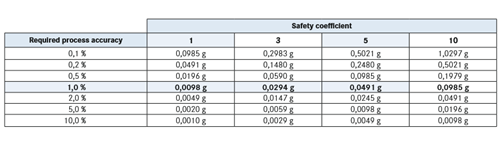
The operator requires his balance to have a process accuracy (of the weighing value) of 1%. With a self-selected safety factor of 1, the minimum weighing capacity according to the table would be 0.0098 g. However, with the same process accuracy but a safety factor of 5, he should not weigh any material weighing less than 0.0491 g on his balance.