



A certificate of conformity provides you with a statement as to whether the balance meets your defined requirements. In conjunction with a calibration certificate with an accreditation symbol, it serves as documented proof that the balance meets the process requirements placed on it. The person responsible for the balance process can choose from various tolerance specifications, depending on their individual requirements:
Certificate of conformity based on measurement uncertainty in use (‘accuracy in use’)
|
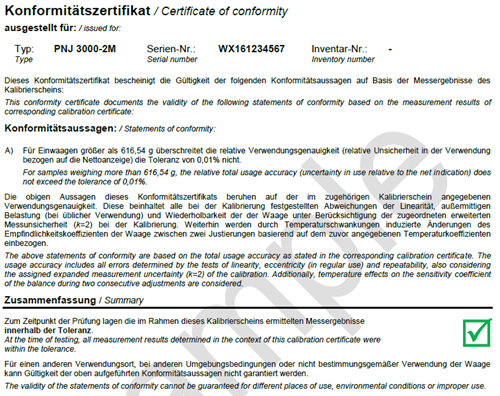
The measurement uncertainty in use (‘accuracy in use’) section of the calibration certificate provides information on the measurement uncertainty to be expected by the user for each weighing operation within the (calibrated) measuring range of the balance. This measurement uncertainty includes the measurement uncertainty of the measured values determined during calibration and also takes into account additional uncertainty components during use (e.g. the temperature drift of the balance). The certificate of conformity can be issued on the basis of a relative (percentage) or absolute (in mg, g, kg, etc.) tolerance. Since the relative measurement uncertainty of a weighing increases as the load decreases, a relative tolerance specification results in a minimum weight below which the desired relative measurement uncertainty is exceeded. This is the so-called minimum weight. In the example shown, with a tolerance of 0.01%, the minimum weighing capacity is 616.54 g – below this, the relative measurement uncertainty of the weighing would be greater than 0.01%. |
 |
|
Option: Conformity assessment based on accuracy of use |
Price |
|---|---|
| as an attachment to the calibration certificate with accr. symbol (relative) as an attachment to the calibration certificate with accr. symbol (absolute) |
on request |
Certificate of conformity based on calibration results
|
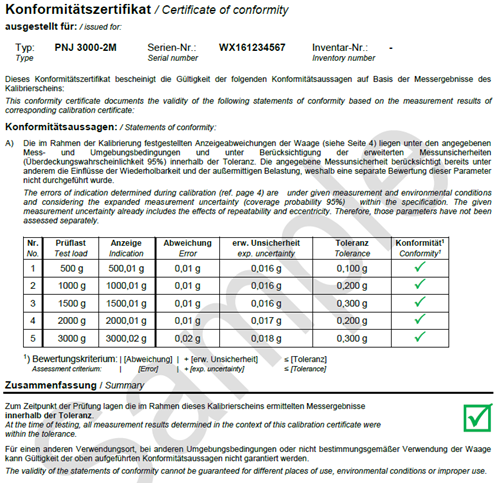
During calibration, the display deviation of the balance is determined at, for example, five test points. Each determined display deviation must be assigned a measurement uncertainty, which includes, for example, the accuracy of the test equipment used. The certificate of conformity shown here assesses the conformity of the balance with the desired tolerance specification based on this determined display deviation plus the expanded measurement uncertainty. However, it does not contain any statement about weighing between these tested points. The certificate of conformity can be issued on the basis of a relative (percentage) or absolute (in mg, g, kg, etc.) tolerance. |
 |
| Option: Conformity assessment based on calibration results | Price |
|---|---|
| as an attachment to the calibration certificate with accr. symbol (relative) as an attachment to the calibration certificate with accr. symbol (absolute) |
on request |
Certificate of conformity based on measured values
|
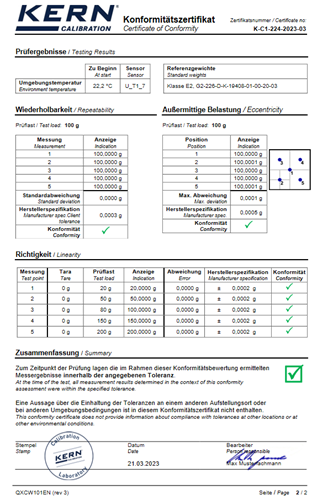
During calibration, various characteristics of the balance are checked, e.g. off-centre loading, repeatability, errors of indication. The certificate of conformity shown here makes a statement about these individual measurement results before they are incorporated into the overall measurement uncertainty. This allows, for example, manufacturer specifications to be verified, but does not provide a comprehensive statement about the measurement uncertainty of future weighings. The measurement uncertainty of individual parameters cannot be taken into account. Only the direct measured values (errors of indication, off-centre loading and/or repeatability) are compared with the specified tolerances (manufacturer or customer tolerance) without taking the uncertainties into account. The certificate of conformity can be issued on the basis of a relative (percentage) or absolute (in mg, g, kg, etc.) tolerance. |
 |
| Option: Conformity assessment based on measured values | Price |
|---|---|
| according to manufacturer's specifications (third-party manufacturer) according to manufacturer's specifications (KERN balances) according to customer specifications |
on request on request on request |